Natural Product (NP) Details
| General Information of the NP (ID: NP8057) | |||||
|---|---|---|---|---|---|
| Name |
Parthenolide
|
||||
| Synonyms |
parthenolide; 20554-84-1; (-)-Parthenolide; MFCD00134592; CHEBI:7939; 4,5-alpha-Epoxy-6-beta-hydroxygermacra-1(10),11(13)-dien-12-oic acid gamma-lactone; (1aR,4E,7aS,10aS,10bR)-1a,5-dimethyl-8-methylidene-2,3,6,7,7a,8,10a,10b-octahydrooxireno[9,10]cyclodeca[1,2-b]furan-9(1aH)-one; (3aS,9aR,10aR,10bS,E)-6,9a-dimethyl-3-methylene-3a,4,5,8,9,9a,10a,10b-octahydrooxireno[2',3':9,10]cyclodeca[1,2-b]furan-2(3H)-one; 29552-41-8; partenolide; Parthenolide, Tanacetum parthenium; Prestwick2_000550; Prestwick3_000550; Epitope ID:115014; SCHEMBL8220; BSPBio_000599; BSPBio_001308; MLS002153872; BPBio1_000659; CHEMBL465158; parthenolide-(alternate-stereo); SCHEMBL13367522; BCBcMAP01_000041; Parthenolide, >=98% (HPLC); HMS1361B10; HMS1569N21; HMS1791B10; HMS1989B10; HMS2096N21; HMS3402B10; HMS3713N21; BCP10404; HY-N0141; ZINC4492886; AKOS016010226; CCG-208244; CS-1919; IDI1_033778; NCGC00163415-01; NCGC00163415-04; AS-17479; SMR001233226; AB0019832; AB00513860; V0355; X-1866; 552P418; Q-100253; (-)-Parthenolide; NSC-157035; NSC 157035; NSC157035; Parthenolide, United States Pharmacopeia (USP) Reference Standard; (1S,2R,4R,7E,11S)-4,8-dimethyl-12-methylidene-3,14-dioxatricyclo[9.3.0.02,4]tetradec-7-en-13-one; (3aS,10R,11R,11aS,6E)-3-Methylene-6,10-dimethyl-10,11-epoxy-1-oxa-2,3,3a,4,5,8,9,10,11,11a-decahydro-1H-cyclopentacyclodecene-2-one
Click to Show/Hide
|
||||
| Species Origin | Tanacetum parthenium ... | Click to Show/Hide | |||
| Tanacetum parthenium | |||||
| Disease | Lung cancer [ICD-11: 2C25] | Investigative | [1] | ||
| Structure |

|
Click to Download Mol2D MOL |
|||
| ADMET Property |
Absporption
Caco-2 Permeability
-4.627
MDCK Permeability
-4.708
PAMPA
- - -
HIA
- - -
Distribution
VDss
0.48
PPB
96.2%
BBB
- - -
Metabolism
CYP1A2 inhibitor
+
CYP1A2 substrate
- -
CYP2C19 inhibitor
+
CYP2C19 substrate
-
CYP2C9 inhibitor
- -
CYP2C9 substrate
- -
CYP2D6 inhibitor
- - -
CYP2D6 substrate
-
CYP3A4 inhibitor
-
CYP3A4 substrate
- -
CYP2B6 inhibitor
+++
CYP2B6 substrate
- - -
CYP2C8 inhibitor
+++
HLM Stability
++
Excretion
CLplasma
10.373
T1/2
2.2
Toxicity
DILI
+
Rat Oral Acute Toxicity
-
FDAMDD
-
Respiratory
- -
Human Hepatotoxicity
+
Ototoxicity
- -
Drug-induced Nephrotoxicity
+
Drug-induced Neurotoxicity
+
Hematotoxicity
-
Genotoxicity
-
Tips: 1. For the classification endpoints, the prediction probability values are transformed into six symbols: 0-0.1 (- - -), 0.1-0.3 (- -), 0.3-0.5 (-), 0.5-0.7 (+), 0.7-0.9 (++), and 0.9-1.0 (+++).
2. Additionally, the corresponding relationships of the three labels are as follows: excellent; medium; poor.
Click to Show/Hide
|
||||
| Click to Show/Hide the Molecular Information and External Link(s) of This Natural Product | |||||
| Formula |
C15H20O3
|
||||
| PubChem CID | |||||
| Canonical SMILES |
CC1=CCCC2(C(O2)C3C(CC1)C(=C)C(=O)O3)C
|
||||
| InChI |
1S/C15H20O3/c1-9-5-4-8-15(3)13(18-15)12-11(7-6-9)10(2)14(16)17-12/h5,11-13H,2,4,6-8H2,1,3H3/b9-5+/t11-,12-,13+,15+/m0/s1
|
||||
| InChIKey |
KTEXNACQROZXEV-PVLRGYAZSA-N
|
||||
| CAS Number |
CAS 20554-84-1
|
||||
| ChEBI ID | |||||
| Herb ID | |||||
| SymMap ID | |||||
| TTD Drug ID | |||||
| Combinatorial Therapeutic Effect(s) Validated Clinically or Experimentally | ||||||
|---|---|---|---|---|---|---|
| α. A List of Drug(s) Whose Efficacy can be Enhanced by This NP | ||||||
| Balsalazide | Indeterminate colitis | Click to Show/Hide the Molecular Data of This Drug | ||||
| Achieving Therapeutic Synergy | Click to Show/Hide | |||||
| Representative Experiment Reporting the Effect of This Combination | [2] | |||||
| Detail(s) |
Combination Info
 click to show the detail info of this combination
|
|||||
| Molecule(s)
Regulation |
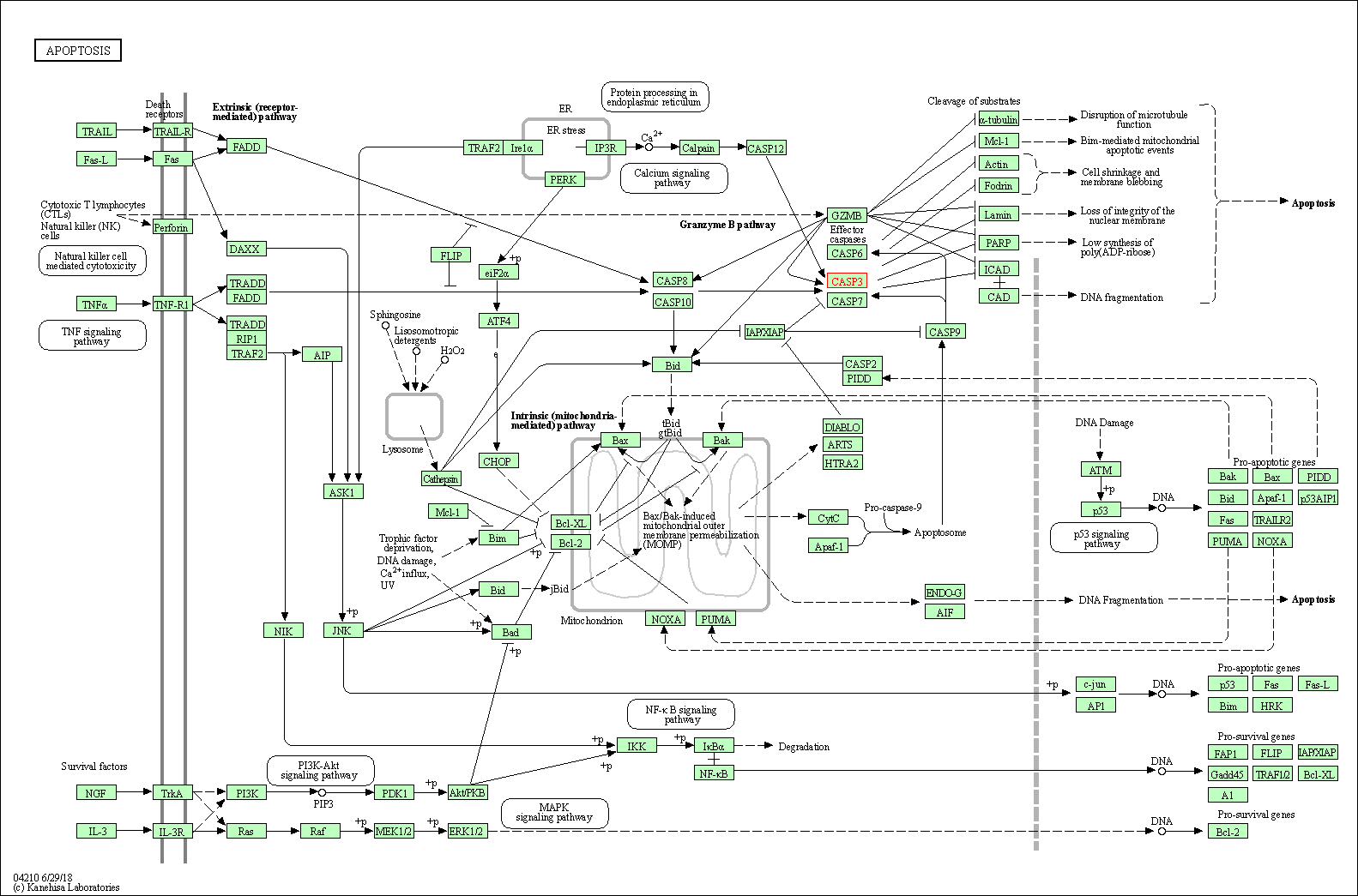
Up-regulation | Cleavage | CASP3 | Molecule Info |
Pathway MAP
|
|
| Up-regulation | Activity | p105 | Molecule Info |
Pathway MAP
|
||
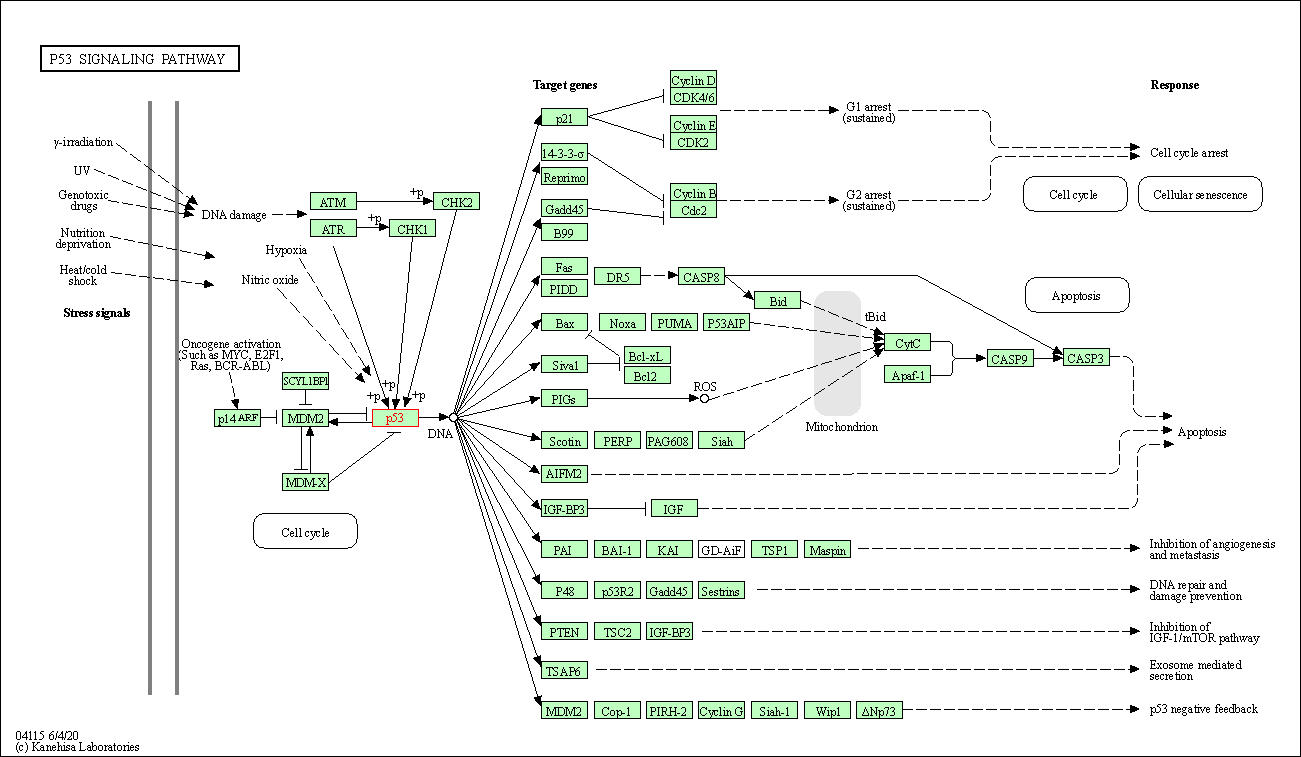
| Up-regulation | Expression | TP53 | Molecule Info |
Pathway MAP
|
||
| In-vitro Model | HCT 116 | CVCL_0291 | Colon carcinoma | Homo sapiens | ||
| SW480 | CVCL_0546 | Colon adenocarcinoma | Homo sapiens | |||
| HT-29 | CVCL_0320 | Colon adenocarcinoma | Homo sapiens | |||
| In-vivo Model | Sixty specific pathogen-free mice (Balb/C female mice, 6 week) were used in this study. | |||||
| Experimental
Result(s) |
Parthenolide potentiates the efficacy of balsalazide through synergistic inhibition of NF-KappaB activation and the combination of dual agents prevents colon carcinogenesis from chronic inflammation. | |||||
| β. A List of Drug(s) Whose Adverse Effect can be Decreased by This NP | ||||||
| Epirubicin | Solid tumour/cancer | Click to Show/Hide the Molecular Data of This Drug | ||||
| Decreasing Adverse Drug Reaction | Click to Show/Hide | |||||
| Representative Experiment Reporting the Effect of This Combination | [3] | |||||
| Detail(s) |
Combination Info
click to show the detail info of this combination
|
|||||
| Molecule(s)
Regulation |
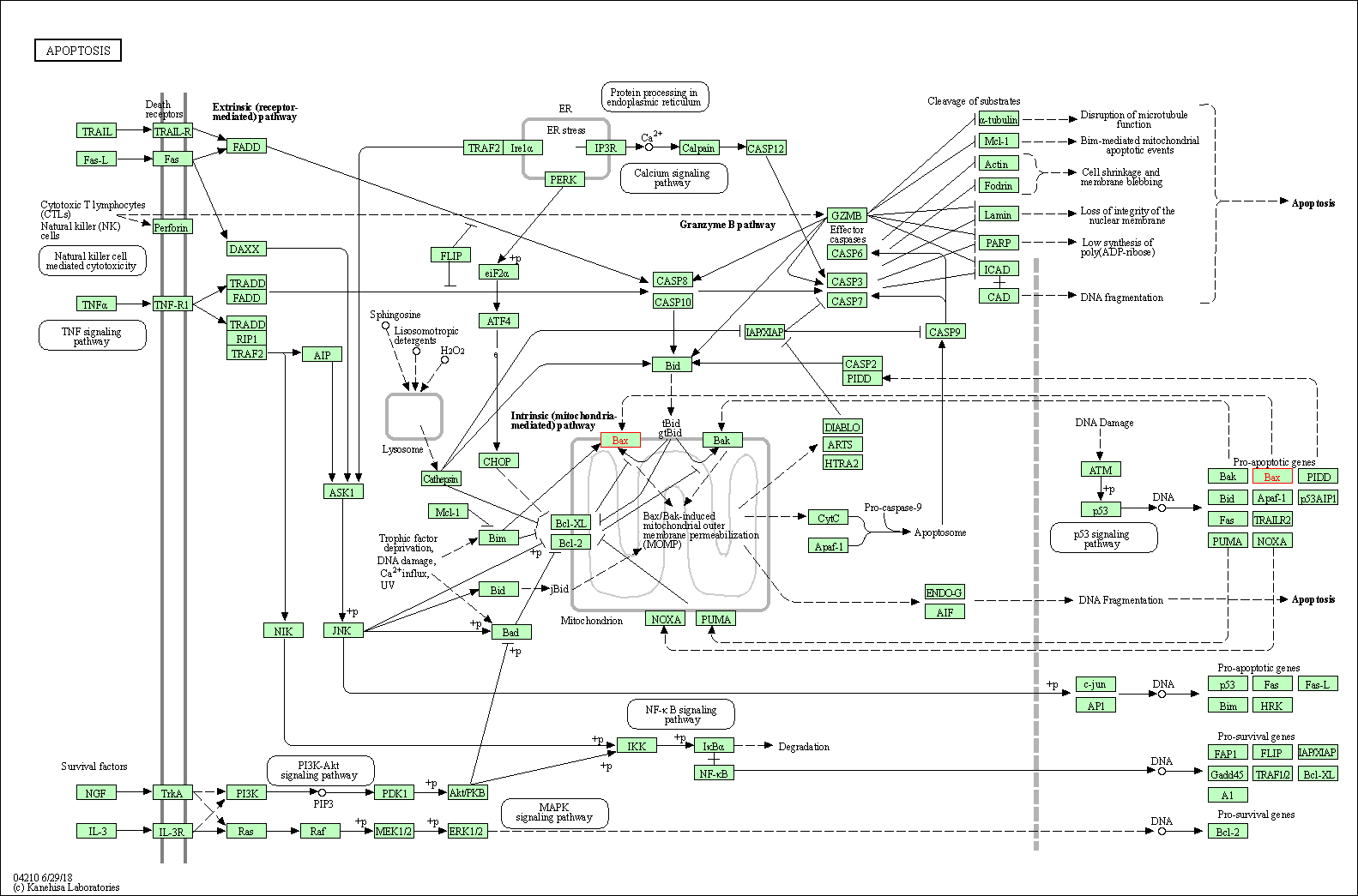
Up-regulation | Expression | BAX | Molecule Info |
Pathway MAP
|
|
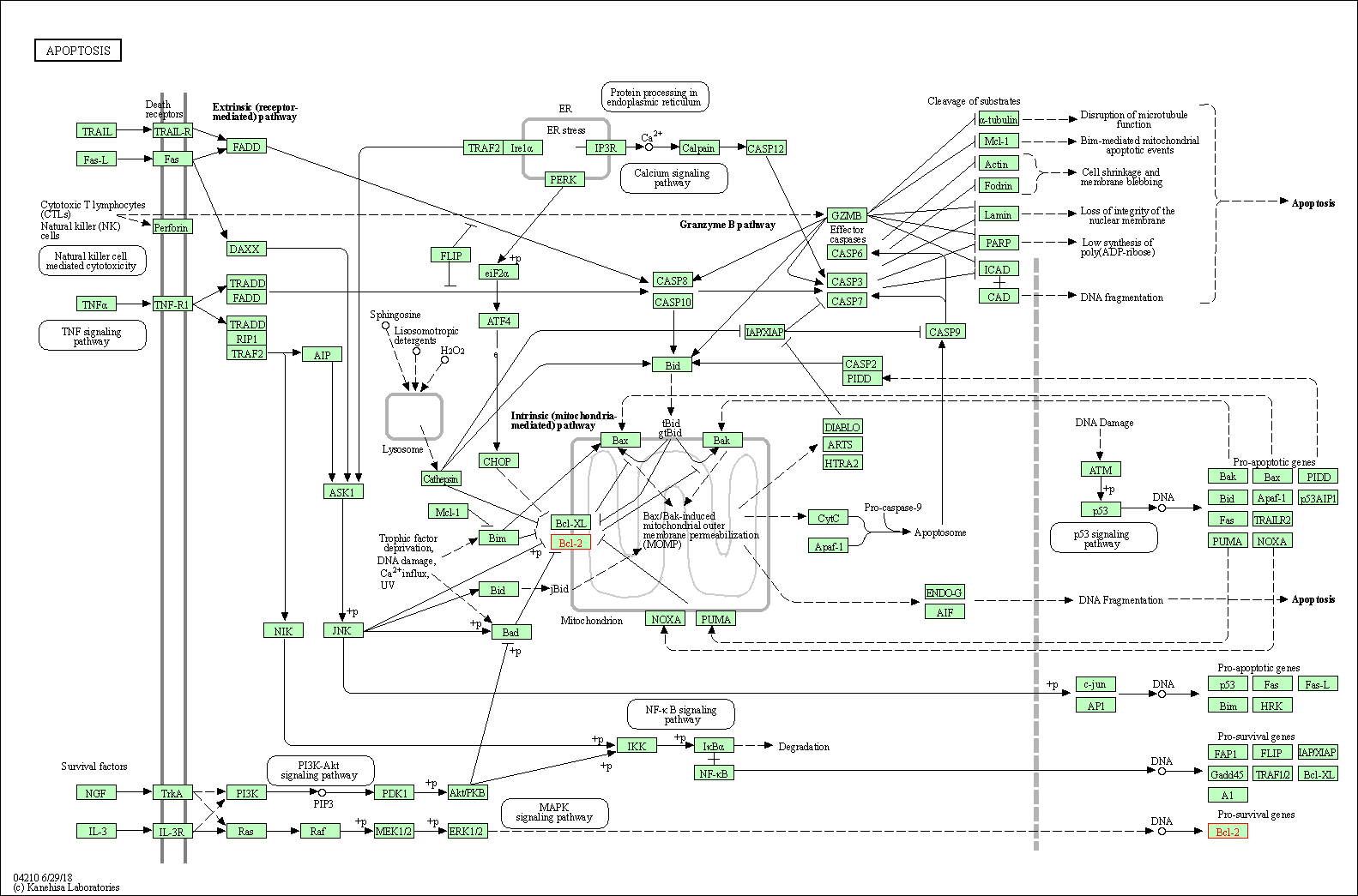
| Down-regulation | Expression | BCL-2 | Molecule Info |
Pathway MAP
|
||
| Up-regulation | Cleavage | CASP3 | Molecule Info |
Pathway MAP
|
||
| In-vitro Model | MDA-MB-468 | CVCL_0419 | Breast adenocarcinoma | Homo sapiens | ||
| Experimental
Result(s) |
Parthenolide along with Epirubicin chemotherapy drug could improve cytotoxicity and apoptosis and reduces IC50. | |||||
| Target and Pathway | ||||
|---|---|---|---|---|
| Target(s) | I-kappa-B-kinase beta (IKKB) | Molecule Info | [4] | |
| Multidrug resistance-associated protein 1 | Molecule Info | |||
| Nuclear factor NF-kappa-B (NFKB) | Molecule Info | [5] | ||
| KEGG Pathway | MAPK signaling pathway | Click to Show/Hide | ||
| 2 | Ras signaling pathway | |||
| 3 | Chemokine signaling pathway | |||
| 4 | NF-kappa B signaling pathway | |||
| 5 | FoxO signaling pathway | |||
| 6 | mTOR signaling pathway | |||
| 7 | PI3K-Akt signaling pathway | |||
| 8 | Apoptosis | |||
| 9 | Osteoclast differentiation | |||
| 10 | Toll-like receptor signaling pathway | |||
| 11 | NOD-like receptor signaling pathway | |||
| 12 | RIG-I-like receptor signaling pathway | |||
| 13 | Cytosolic DNA-sensing pathway | |||
| 14 | T cell receptor signaling pathway | |||
| 15 | B cell receptor signaling pathway | |||
| 16 | TNF signaling pathway | |||
| 17 | Neurotrophin signaling pathway | |||
| 18 | Insulin signaling pathway | |||
| 19 | Adipocytokine signaling pathway | |||
| 20 | Type II diabetes mellitus | |||
| 21 | Non-alcoholic fatty liver disease (NAFLD) | |||
| 22 | Epithelial cell signaling in Helicobacter pylori infection | |||
| 23 | Shigellosis | |||
| 24 | Chagas disease (American trypanosomiasis) | |||
| 25 | Toxoplasmosis | |||
| 26 | Hepatitis C | |||
| 27 | Hepatitis B | |||
| 28 | Influenza A | |||
| 29 | HTLV-I infection | |||
| 30 | Herpes simplex infection | |||
| 31 | Epstein-Barr virus infection | |||
| 32 | Pathways in cancer | |||
| 33 | MicroRNAs in cancer | |||
| 34 | Pancreatic cancer | |||
| 35 | Prostate cancer | |||
| 36 | Chronic myeloid leukemia | |||
| 37 | Acute myeloid leukemia | |||
| 38 | Small cell lung cancer | |||
| 39 | Legionellosis | |||
| 40 | Viral carcinogenesis | |||
| NetPath Pathway | IL5 Signaling Pathway | Click to Show/Hide | ||
| Panther Pathway | Apoptosis signaling pathway | Click to Show/Hide | ||
| 2 | B cell activation | |||
| 3 | Inflammation mediated by chemokine and cytokine signaling pathway | |||
| 4 | Interleukin signaling pathway | |||
| 5 | PDGF signaling pathway | |||
| 6 | T cell activation | |||
| 7 | Toll receptor signaling pathway | |||
| Pathwhiz Pathway | Intracellular Signalling Through Adenosine Receptor A2a and Adenosine | Click to Show/Hide | ||
| 2 | Intracellular Signalling Through Adenosine Receptor A2b and Adenosine | |||
| Pathway Interaction Database | Fc-epsilon receptor I signaling in mast cells | Click to Show/Hide | ||
| 2 | BCR signaling pathway | |||
| 3 | GMCSF-mediated signaling events | |||
| 4 | Atypical NF-kappaB pathway | |||
| 5 | TCR signaling in naï | |||
| 6 | ||||
| 7 | Canonical NF-kappaB pathway | |||
| 8 | TRAIL signaling pathway | |||
| 9 | TCR signaling in naï | |||
| 10 | ||||
| 11 | FAS (CD95) signaling pathway | |||
| 12 | IL1-mediated signaling events | |||
| 13 | mTOR signaling pathway | |||
| 14 | TNF receptor signaling pathway | |||
| 15 | FoxO family signaling | |||
| 16 | p75(NTR)-mediated signaling | |||
| 17 | Validated transcriptional targets of TAp63 isoforms | |||
| 18 | Endogenous TLR signaling | |||
| 19 | IL12-mediated signaling events | |||
| 20 | Alternative NF-kappaB pathway | |||
| Reactome | Activation of NF-kappaB in B cells | Click to Show/Hide | ||
| 2 | NOD1/2 Signaling Pathway | |||
| 3 | RIP-mediated NFkB activation via ZBP1 | |||
| 4 | p75NTR recruits signalling complexes | |||
| 5 | NF-kB is activated and signals survival | |||
| 6 | FCERI mediated NF-kB activation | |||
| 7 | TAK1 activates NFkB by phosphorylation and activation of IKKs complex | |||
| 8 | Interleukin-1 signaling | |||
| 9 | Regulation of TNFR1 signaling | |||
| 10 | TNFR1-induced NFkappaB signaling pathway | |||
| 11 | IKBKB deficiency causes SCID | |||
| 12 | IKBKG deficiency causes anhidrotic ectodermal dysplasia with immunodeficiency (EDA-ID) (via TLR) | |||
| 13 | IkBA variant leads to EDA-ID | |||
| 14 | CLEC7A (Dectin-1) signaling | |||
| 15 | MAP3K8 (TPL2)-dependent MAPK1/3 activation | |||
| 16 | TRAF6 mediated NF-kB activation | |||
| 17 | NF-kB activation through FADD/RIP-1 pathway mediated by caspase-8 and -10 | |||
| 18 | IRAK1 recruits IKK complex | |||
| 19 | IKK complex recruitment mediated by RIP1 | |||
| 20 | IRAK1 recruits IKK complex upon TLR7/8 or 9 stimulation | |||
| 21 | DEx/H-box helicases activate type I IFN and inflammatory cytokines production | |||
| 22 | Interleukin-1 processing | |||
| 23 | Dectin-1 mediated noncanonical NF-kB signaling | |||
| 24 | NIK-->noncanonical NF-kB signaling | |||
| WikiPathways | Toll-like receptor signaling pathway | Click to Show/Hide | ||
| 2 | Estrogen signaling pathway | |||
| 3 | TCR Signaling Pathway | |||
| 4 | Insulin Signaling | |||
| 5 | IL-4 Signaling Pathway | |||
| 6 | MAPK Signaling Pathway | |||
| 7 | NLR Proteins | |||
| 8 | Hair Follicle Development: Induction (Part 1 of 3) | |||
| 9 | MyD88 cascade initiated on plasma membrane | |||
| 10 | Cardiac Hypertrophic Response | |||
| 11 | Cytosolic sensors of pathogen-associated DNA | |||
| 12 | MyD88 dependent cascade initiated on endosome | |||
| 13 | Nucleotide-binding domain, leucine rich repeat containing receptor (NLR) signaling pathways | |||
| 14 | MyD88:Mal cascade initiated on plasma membrane | |||
| 15 | Fc epsilon receptor (FCERI) signaling | |||
| 16 | MyD88-independent cascade | |||
| 17 | Signaling by the B Cell Receptor (BCR) | |||
| 18 | TAK1 activates NFkB by phosphorylation and activation of IKKs complex | |||
| 19 | Structural Pathway of Interleukin 1 (IL-1) | |||
| 20 | EBV LMP1 signaling | |||
| 21 | Polycystic Kidney Disease Pathway | |||
| 22 | Apoptosis | |||
| 23 | Quercetin and Nf-kB/ AP-1 Induced Cell Apoptosis | |||
| 24 | BDNF signaling pathway | |||
| 25 | Interleukin-11 Signaling Pathway | |||
| 26 | AGE/RAGE pathway | |||
| 27 | TNF alpha Signaling Pathway | |||
| 28 | B Cell Receptor Signaling Pathway | |||
| 29 | IL17 signaling pathway | |||
| 30 | TWEAK Signaling Pathway | |||
| 31 | Leptin signaling pathway | |||
| 32 | RANKL/RANK Signaling Pathway | |||
| 33 | Signalling by NGF | |||
| 34 | IL-1 signaling pathway | |||
| 35 | TCR signaling | |||
| 36 | RIG-I/MDA5 mediated induction of IFN-alpha/beta pathways | |||
| 37 | Interleukin-1 signaling | |||
| 38 | Apoptosis Modulation and Signaling | |||
| 39 | Type II diabetes mellitus | |||
| 40 | MicroRNAs in cardiomyocyte hypertrophy | |||
| 41 | Regulation of toll-like receptor signaling pathway | |||
| 42 | Osteopontin Signaling | |||
| 43 | NOD pathway | |||
| 44 | DNA Damage Response (only ATM dependent) | |||
| 45 | SIDS Susceptibility Pathways | |||
| 46 | Nuclear Receptors Meta-Pathway | |||
| 47 | TSLP Signaling Pathway | |||
| 48 | Neural Crest Differentiation | |||
| 49 | Interleukin-1 processing | |||
| 50 | Folate Metabolism | |||
| 51 | Vitamin B12 Metabolism | |||
| 52 | Selenium Micronutrient Network | |||