Drug Details
| General Information of the Drug (ID: DR2980) | ||||
|---|---|---|---|---|
| Name |
Simvastatin
|
|||
| Synonyms |
simvastatin; 79902-63-9; Zocor; Synvinolin; Sinvacor; Denan; Lipex; MK-733; Sivastin; Lodales; Simvastatine; Cholestat; Colemin; Simovil; Medipo; Pantok; Simvastatina; Simvastatinum; Velostatin; Zocord; Zorced; Simvastatin lactone; Simvastatin (Zocor); Lipovas; Simcard; Simvacor; Simvoget; Rechol; Simlup; (1S,3R,7S,8S,8aR)-8-(2-((2R,4R)-4-Hydroxy-6-oxotetrahydro-2H-pyran-2-yl)ethyl)-3,7-dimethyl-1,2,3,7,8,8a-hexahydronaphthalen-1-yl 2,2-dimethylbutanoate; MK-0733; UNII-AGG2FN16EV; 2,2-Dimethylbutyric acid, 8-ester with (4R,6R)-6-(2-((1S,2S,6R,8S,8aR)-1,2,6,7,8,8a-hexahydro-8-hydroxy-2,6-dimethyl-1-naphthyl)ethyl)tetrahydro-4-hydroxy-2H-pyran-2-one; AGG2FN16EV; CHEBI:9150; (1S,3R,7S,8S,8aR)-8-{2-[(2R,4R)-4-hydroxy-6-oxotetrahydro-2H-pyran-2-yl]ethyl}-3,7-dimethyl-1,2,3,7,8,8a-hexahydronaphthalen-1-yl 2,2-dimethylbutanoate; [(1S,3R,7S,8S,8aR)-8-[2-[(2R,4R)-4-hydroxy-6-oxooxan-2-yl]ethyl]-3,7-dimethyl-1,2,3,7,8,8a-hexahydronaphthalen-1-yl] 2,2-dimethylbutanoate; Labistatin; Coledis; Corolin; Nivelipol; Rendapid; Vasotenal; Simcor; Simvastatin, 98%; Butanoic acid, 2,2-dimethyl-, (1S,3R,7S,8S,8aR)-1,2,3,7,8,8a-hexahydro-3,7-dimethyl-8-[2-[(2R,4R)-tetrahydro-4-hydroxy-6-oxo-2H-pyran-2-yl]ethyl]-1-naphthalenyl ester; C25H38O5; Simvastatine [French]; Simvastatinum [Latin]; Simvastatina [Spanish]; DSSTox_CID_3581; DSSTox_RID_77090; DSSTox_GSID_23581; (1S,3R,7S,8S,8aR)-8-{2-[(2R,4R)-4-hydroxy-6-oxooxan-2-yl]ethyl}-3,7-dimethyl-1,2,3,7,8,8a-hexahydronaphthalen-1-yl 2,2-dimethylbutanoate; Butanoic acid, 2,2-dimethyl-, (1S,3R,7S,8S,8aR)-1,2,3,7,8,8a-hexahydro-3,7-dimethyl-8-(2-((2R,4R)-tetrahydro-4-hydroxy-6-oxo-2H-pyran-2-yl)ethyl)-1-naphthalenyl ester; Zosta; Simvast CR; DRG-0320; [(1S,3R,7S,8S,8aR)-8-[2-[(2R,4R)-4-hydroxy-6-oxo-tetrahydropyran-2-yl]ethyl]-3,7-dimethyl-1,2,3,7,8,8a-hexahydronaphthalen-1-yl] 2,2-dimethylbutanoate; SMR000718785; MK 0733; CCRIS 7558; Zocor (TN); HSDB 7208; Simvastatin & Primycin; SR-05000001894; MK 733; L 644128-000U; BRN 4768037; Kolestevan; Lipinorm; Modutrol; Simvotin; Sinvascor; Valemia; Eucor; MFCD00072007; Nor-Vastina; Simvastatin,(S); C10AA01; simvastatin predrug; (+)-Simvastatin; NCGC00016940-01; inactive simvastatin; 8-[2-((2R,4R)-4-hydroxy-6-oxo(2H-3,4,5-trihydropyran-2-yl))ethyl](1S,7S,8S,3R, 8aR)-3,7-dimethyl-1,2,3,7,8,8a-hexahydronaphthyl 2,2-dimethylbutanoate; Simvastatin [USAN:USP:INN:BAN]; TNP00259; Prestwick_171; CAS-79902-63-9; KS-1113; Spectrum_001717; SpecPlus_000895; Prestwick0_000865; Prestwick1_000865; Prestwick2_000865; Prestwick3_000865; Spectrum2_001671; Spectrum3_000669; Spectrum4_000632; Spectrum5_001428; SCHEMBL2471; CHEMBL1064; BSPBio_000909; BSPBio_002337; KBioGR_001244; KBioSS_002197; MLS001304029; MLS001333077; MLS001333078; MLS002154038; MLS006011866; ARONIS24119; BIDD:GT0769; DivK1c_006991; SPECTRUM1504236; SPBio_001881; SPBio_002830; BPBio1_001001; GTPL2955; Simvastatin (JP17/USP/INN); Simvastatin, analytical standard; DTXSID0023581; BCBcMAP01_000007; KBio1_001935; KBio2_002197; KBio2_004765; KBio2_007333; KBio3_001557; RYMZZMVNJRMUDD-HGQWONQESA-; HMS1570N11; HMS1922H13; HMS2089D12; HMS2093E06; HMS2097N11; HMS2231N22; HMS3259B12; HMS3412P08; HMS3676P08; HMS3714N11; HMS3884G10; Pharmakon1600-01504236; ZINC3780893; Tox21_110696; Tox21_300400; BBL024390; BDBM50139181; CCG-39069; NSC633782; NSC758706; s1792; SBB080618; STK801938; AKOS005111006; AKOS015842733; Simvastatin, >=97% (HPLC), solid; Tox21_110696_1; AC-1530; AT-7048; DB00641; MCULE-8390617062; NC00719; NSC 758706; NSC-633782; NSC-758706; MRF-0000729; NCGC00017324-01; NCGC00017324-02; NCGC00017324-03; NCGC00017324-04; NCGC00017324-05; NCGC00017324-07; NCGC00017324-08; NCGC00017324-09; NCGC00254418-01; 2,2-Dimethylbutanoic acid (1S,3R,7S,8S,8aR)-1,2,3,7,8,8a-hexahydro-3,7-dimethyl-8-[2-[(2R,4R)-tetrahydro-4-hydroxy-6-oxo-2H-pyran-2-yl]ethyl]-1-naphthalenyl ester; Butanoic acid, 2,2-dimethyl-, 1,2,3,7,8,8a-hexahydro-3,7-dimethyl-8-(2-(tetrahydro-4-hydroxy-6-oxo-2H-pyran-2-yl)ethyl)-1-naphthalenyl ester, (1S-(1alpha,3alpha,7beta,8beta(2S*,4S*),8abeta))-; HY-17502; ST057168; SBI-0206773.P001; Simvastatin 100 microg/mL in Acetonitrile; AB0069097; D00434; J10128; W-3044; 28049-EP2269989A1; 28049-EP2269990A1; 28049-EP2270011A1; 28049-EP2270505A1; 28049-EP2272825A2; 28049-EP2272841A1; 28049-EP2277865A1; 28049-EP2280001A1; 28049-EP2280006A1; 28049-EP2281813A1; 28049-EP2284158A1; 28049-EP2287165A2; 28049-EP2287166A2; 28049-EP2292620A2; 28049-EP2295406A1; 28049-EP2295409A1; 28049-EP2295417A1; 28049-EP2295422A2; 28049-EP2298731A1; 28049-EP2298742A1; 28049-EP2298745A1; 28049-EP2298769A1; 28049-EP2298772A1; 28049-EP2298776A1; 28049-EP2298779A1; 28049-EP2301923A1; 28049-EP2301931A1; 28049-EP2301936A1; 28049-EP2305219A1; 28049-EP2305648A1; 28049-EP2308839A1; 28049-EP2308878A2; 28049-EP2314588A1; 96639-EP2287163A1; 96639-EP2305678A1; 99548-EP2270011A1; 99548-EP2298779A1; 99548-EP2301923A1; 99548-EP2301931A1; AB00053395-07; AB00053395-08; AB00053395-10; AB00053395_11; AB00053395_13; 902S639; Q670131; SR-05000001894-1; SR-05000001894-2; BRD-K22134346-001-05-8; BRD-K22134346-001-11-6; BRD-K22134346-001-15-7; Z1741982918; Simvastatin, British Pharmacopoeia (BP) Reference Standard; Simvastatin, European Pharmacopoeia (EP) Reference Standard; Simvastatin, United States Pharmacopeia (USP) Reference Standard; Simvastatin, Pharmaceutical Secondary Standard; Certified Reference Material; Simvastatin for peak identification, European Pharmacopoeia (EP) Reference Standard; (1S,3R,7S,8S,8aR)-1,2,3,7,8,8a-Hexahydro-3,7-dimethyl-8-[2-[(2R,4R)-tetrahydro-4-hydroxy-6-oxo-2H-pyran-2-yl]ethyl]-1-naphthalenyly-2,2-dimethyl butanoate; (1S,3R,7S,8S,8aR)-8-(2-((2R,4R)-4-Hydroxy-6-oxotetrahydro-2H-pyran-2-yl)ethyl)-3,7-dimethyl-1,2,3,7,8,8a-hexahydronaphthalen-1-yl 2,2-dimethylbu; (1S,7S,8S,8aR)-8-{2-[(2R,4R)-4-hydroxy-6-oxooxan-2-yl]ethyl}-3,7-dimethyl-1,2,3,7,8,8a-hexahydronaphthalen-1-yl 2,2-dimethylbutanoate
Click to Show/Hide
|
|||
| Molecular Type |
Small molecule
|
|||
| Disease | Hypertriglyceridaemia [ICD-11: 5C80] | Approved | [1] | |
| Structure |

|
Click to Download Mol2D MOL |
||
| ADMET Property |
Absorption Tmax
The time to maximum plasma concentration (Tmax) is 1.3-2.4 h
BDDCS Class
Biopharmaceutics Drug Disposition Classification System (BDDCS) Class 2: low solubility and high permeability
Elimination
13% of the dose was excreted in urine and 60% in feces
Half-life
The concentration or amount of drug in body reduced by one-half in 4.85 hours
Metabolism
The drug is metabolized via a combination of spontaneous chemical conversion and enzyme-mediated hydrolysis by nonspecific carboxyesterases in the intestinal wall, liver, and plasma
MRTD
The Maximum Recommended Therapeutic Dose (MRTD) of drug that ensured maximising efficacy and moderate side effect is 1.3652 micromolar/kg/day
Water Solubility
The ability of drug to dissolve in water is measured as 0.03 mg/mL
Click to Show/Hide
|
|||
| Click to Show/Hide the Molecular Information and External Link(s) of This Natural Product | ||||
| Formula |
C25H38O5
|
|||
| PubChem CID | ||||
| Canonical SMILES |
CCC(C)(C)C(=O)OC1CC(C=C2C1C(C(C=C2)C)CCC3CC(CC(=O)O3)O)C
|
|||
| InChI |
1S/C25H38O5/c1-6-25(4,5)24(28)30-21-12-15(2)11-17-8-7-16(3)20(23(17)21)10-9-19-13-18(26)14-22(27)29-19/h7-8,11,15-16,18-21,23,26H,6,9-10,12-14H2,1-5H3/t15-,16-,18+,19+,20-,21-,23-/m0/s1
|
|||
| InChIKey |
RYMZZMVNJRMUDD-HGQWONQESA-N
|
|||
| CAS Number |
CAS 79902-63-9
|
|||
| ChEBI ID | ||||
| TTD Drug ID | ||||
| DrugBank ID | ||||
| Combinatorial Therapeutic Effect(s) Validated Clinically or Experimentally | ||||||
|---|---|---|---|---|---|---|
| α. A List of Natural Product(s) Able to Enhance the Efficacy of This Drug | ||||||
| Alpha tricalcium phosphate | Animal bone | Click to Show/Hide the Molecular Data of This NP | ||||
| Achieving Therapeutic Synergy | Click to Show/Hide | |||||
| Representative Experiment Reporting the Effect of This Combination | [2] | |||||
| Detail(s) |
Combination Info
 click to show the detail info of this combination
|
|||||
| In-vivo Model | Bilateral 5-mm-diameter calvarial defects were created in adult Wistar rats and filled with preparations of different doses of simvastatin (0, 0.01, 0.1, 0.25 and 0.5 mg) combined with a-TCP particles or left empty. | |||||
| Experimental
Result(s) |
When combined with alpha-TCP particles, 0.1 mg simvastatin is the optimal dose for stimulation of the maximum bone regeneration in rat calvarial defects without inducing inflammation. | |||||
| Gamma tocotrienol | Bixa orellana | Click to Show/Hide the Molecular Data of This NP | ||||
| Achieving Therapeutic Synergy | Click to Show/Hide | |||||
| Representative Experiment Reporting the Effect of This Combination | [3] | |||||
| Detail(s) |
Combination Info
click to show the detail info of this combination
|
|||||
| Molecule(s)
Regulation |
Down-regulation | Phosphorylation | AKT1 | Molecule Info |
Pathway MAP
|
|
| Down-regulation | Phosphorylation | ERK2 | Molecule Info |
Pathway MAP
|
||
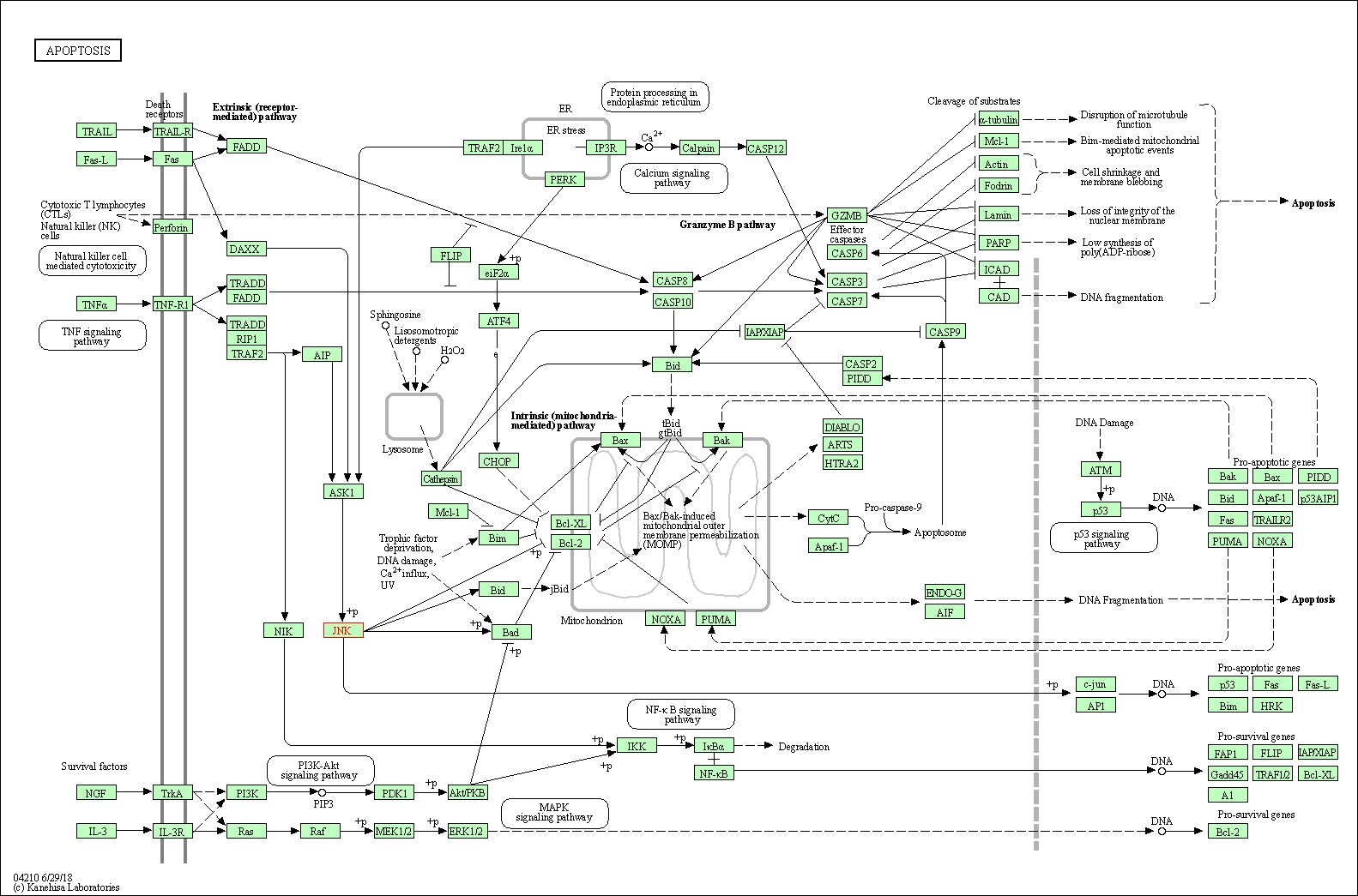
| Down-regulation | Phosphorylation | JNK1 | Molecule Info |
Pathway MAP
|
||
| Down-regulation | Phosphorylation | p38 beta | Molecule Info |
Pathway MAP
|
||
| In-vitro Model | Neoplastic mouse +SA mammary epithelial cells | Healthy | Rattus norvegicus | |||
| Experimental
Result(s) |
Treatment with subeffective doses of simvastatin or gamma-tocotrienol alone had no effect, whereas combined treatment of these compounds resulted in a relatively large decrease in intracellular levels of phosphorylated (activated) MAPK, JNK, p38, and Akt. | |||||
| Geraniol | Rosa rugosa | Click to Show/Hide the Molecular Data of This NP | ||||
| Achieving Therapeutic Synergy | Click to Show/Hide | |||||
| Representative Experiment Reporting the Effect of This Combination | [4] | |||||
| Detail(s) |
Combination Info
click to show the detail info of this combination
|
|||||
| Biological
Regulation |
Inhibition | Cholesterol biosynthesis | ||||
| In-vitro Model | Hep-G2 | CVCL_0027 | Hepatocellular carcinoma | Homo sapiens | ||
| Experimental
Result(s) |
Geraniol and simvastatin show a synergistic effect on a human hepatocarcinoma cell line. | |||||
| Magnesium | Magnesite | Click to Show/Hide the Molecular Data of This NP | ||||
| Achieving Therapeutic Synergy | Click to Show/Hide | |||||
| Representative Experiment Reporting the Effect of This Combination | [5] | |||||
| Detail(s) |
Combination Info
click to show the detail info of this combination
|
|||||
| In-vivo Model | C57BL/6 male mice were fed with a HFD or a normal-fat diet (NFD). | |||||
| Experimental
Result(s) |
The combination of Mg2+ and SIM shows a synergistic effect on attenuating the HFD-induced bone loss. | |||||
| Metformin | Galega officinalis | Click to Show/Hide the Molecular Data of This NP | ||||
| Achieving Therapeutic Synergy | Click to Show/Hide | |||||
| Representative Experiment Reporting the Effect of This Combination | [6] | |||||
| Detail(s) |
Combination Info
click to show the detail info of this combination
|
|||||
| Molecule(s)
Regulation |
Up-regulation | Expression | PRKAA2 | Molecule Info |
Pathway MAP
|
|
| In-vitro Model | PC-3 D12 | CVCL_4Y40 | Prostate carcinoma | Homo sapiens | ||
| LNCaP C4-2B5 | CVCL_4788 | Prostate carcinoma | Homo sapiens | |||
| LNCaP C4-2B4 | CVCL_4787 | Prostate carcinoma | Homo sapiens | |||
| LNCaP C4-2B3 | CVCL_4786 | Prostate carcinoma | Homo sapiens | |||
| MDA-MB-231 | CVCL_0062 | Breast adenocarcinoma | Homo sapiens | |||
| In-vivo Model | Male NCr-nu/nu mice were used in this study. | |||||
| Experimental
Result(s) |
Combination of simvastatin and metformin, within pharmacologic dose range (500 nmol/L to 4 umol/L simvastatin and 250 umol/L to 2 mmol/L metformin), significantly and synergistically reduces C4-2B3/B4 CRPC cell viability and metastatic properties, with minimal adverse effects on normal prostate epithelial cells. | |||||
| Pinocembrin | Eucalyptus | Click to Show/Hide the Molecular Data of This NP | ||||
| Achieving Therapeutic Synergy | Click to Show/Hide | |||||
| Representative Experiment Reporting the Effect of This Combination | [7] | |||||
| Detail(s) |
Combination Info
click to show the detail info of this combination
|
|||||
| Molecule(s)
Regulation |
Down-regulation | Expression | VEGFA | Molecule Info |
Pathway MAP
|
|
| In-vivo Model | ApoE / mice (8 weeks old) were fed a high fat diet (21% fat and 0.15% cholesterol). | |||||
| Experimental
Result(s) |
The combination of simvastatin and pinocembrin synergistically inhibited atherosclerotic lesion development in ApoE-/- mice with hyperlipidemia, which is partially dependent on the protective of vascular endothelium. | |||||
| Target and Pathway | ||||
|---|---|---|---|---|
| Target(s) | HMG-CoA reductase (HMGCR) | Molecule Info | [8] | |
| BioCyc | Superpathway of geranylgeranyldiphosphate biosynthesis I (via mevalonate) | Click to Show/Hide | ||
| 2 | Superpathway of cholesterol biosynthesis | |||
| 3 | Mevalonate pathway | |||
| KEGG Pathway | Terpenoid backbone biosynthesis | Click to Show/Hide | ||
| 2 | Metabolic pathways | |||
| 3 | Biosynthesis of antibiotics | |||
| 4 | AMPK signaling pathway | |||
| 5 | Bile secretion | |||
| NetPath Pathway | IL5 Signaling Pathway | Click to Show/Hide | ||
| 2 | TGF_beta_Receptor Signaling Pathway | |||
| 3 | TSH Signaling Pathway | |||
| Panther Pathway | Cholesterol biosynthesis | Click to Show/Hide | ||
| Pathwhiz Pathway | Steroid Biosynthesis | Click to Show/Hide | ||
| WikiPathways | Statin Pathway | Click to Show/Hide | ||
| 2 | Regulation of Lipid Metabolism by Peroxisome proliferator-activated receptor alpha (PPARalpha) | |||
| 3 | Activation of Gene Expression by SREBP (SREBF) | |||
| 4 | SREBF and miR33 in cholesterol and lipid homeostasis | |||
| 5 | Integrated Breast Cancer Pathway | |||
| 6 | SREBP signalling | |||
| 7 | Cholesterol Biosynthesis | |||